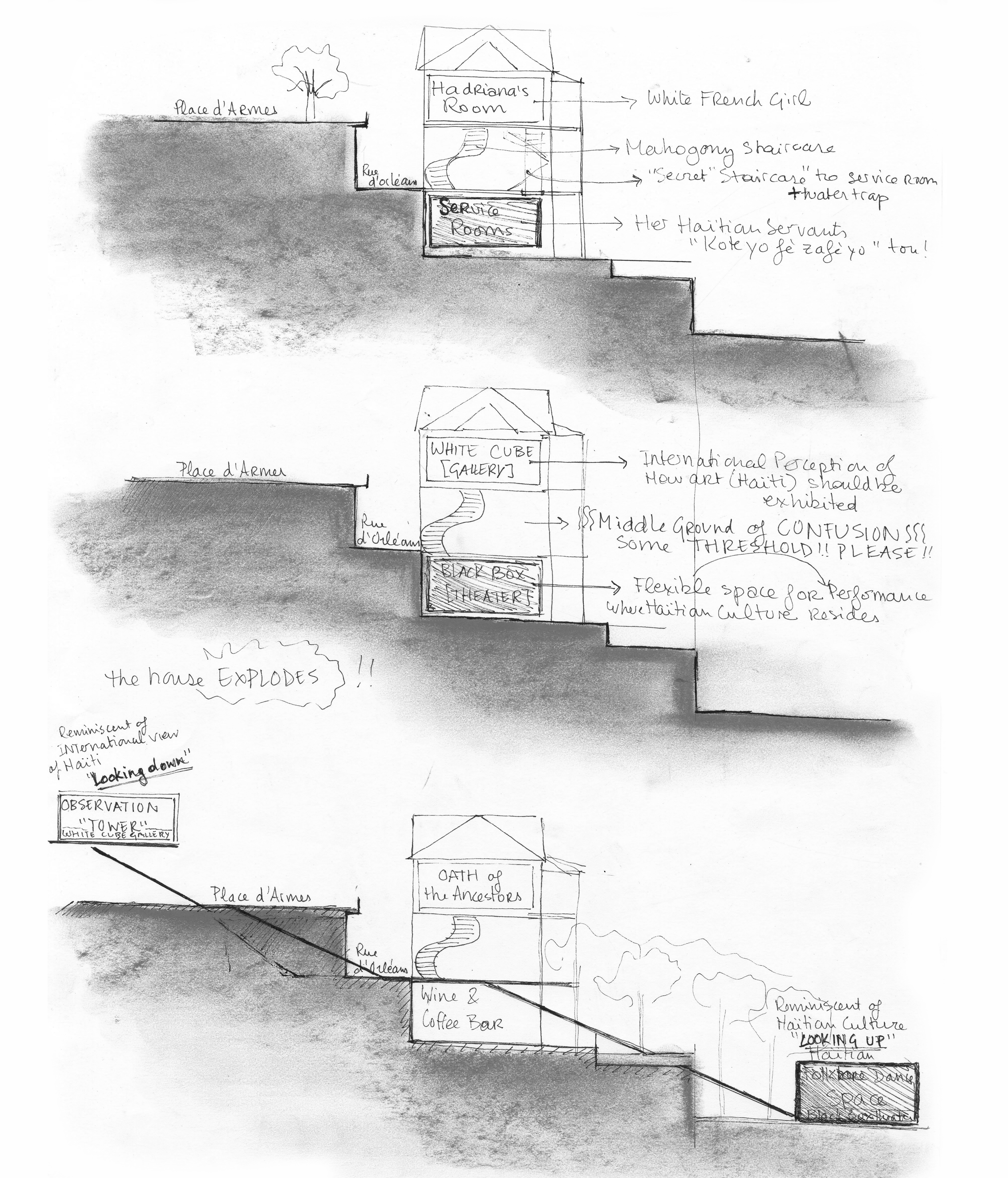
Up in the Air

For my second to last official thesis review, I suggested a scheme inspired by viaplana’s light steel structure in Barcelona, which delineates a path through the plaza….

Weary of an approach that reminds me way too much of all the elevated schemes in architecture these days (the High Line in NY being the most popular) I still attempted to test this design:

Mahogany stairs

Mahogany, or acajou, was a highly prized tree native to the Caribbean island of Saint-Domingue and almost entirely deforested during the eighteenth century to satisfy the vogue for furniture in the dark wood. The wood for the bridge as well as for a mahogany garden pavilion echoing the mahogany pavilions on the Laborde plantations was supplied directly from Laborde’s sugar estates.

Sowing Empire: Landscape and Colonization | Jil Casid

Jeux d’Enfants

On my second visit to Jacmel during my Spring Break, I reached the public plaza when the sun was setting down. It was lively with many younger Jacmelians hanging out, riding their bikes, playing soccer or basketball… There was an old tractor parked on the plaza and a group of kids used it as a music instrument, some of them beat on the machine like a drum while others jumped up and down on its huge tires. They created a really catchy beat. It was my first time experiencing such a lively scene of the plaza. It was surprising to me to see Jacmelians enjoy the public space because they often times criticized the government for having cut down its trees.

While the plaza does suffer from a lack shade due to the loss of its trees, it seems important to keep the young energy of Jacmelians alive in the park. From what my mother recalls of her visit to Jacmel, the trees did not allow for much space to linger. The space of the Jacmel plaza is limited but it should allow for kids to find an appropriate space of leisure. The makeshift basketball court attracted many of them on that Sunday afternoon.


3rd Movement: Oath of the Ancestors

Slide 1

We took the road very early this morning for our field trip to Jacmel. The nuns got a great deal from the government and we took the road on the colorful new buses they’ve acquired from the Venezuelan government


Slide 2

The nuns at my school had a great deal from the governemnt’s new hydraulic bus system and thus we were riding in style in a large colorful bus

Slide 3

As soon as we found ourselves holding onto our seats, we knew we were approaching Jacmel. The winding road “Rue de l’Amitié or Frienship road was


We left Port-au-Prince very early this morning and took the road to Jacmel a picturesque city in the South-Eastern coast of Haiti. It very early this morning to avoid the traffic from Carrefour Feuille. The nuns got a great deal from the government and we took the road on the colorful new buses they’ve acquired from the Venezuelan government

AS soon as we found ourselves having to hold on to our seats, we knew we were getting closer. The friendship road, a gift by t the French Government to Jacmel is a winding road that hugs all the curves of the valleys of the Sougth-East. As we reached the middle of town, the flat central plaza revealed itself to us and all the buildings around the plaza which had recently been renovated revealed themselves to us like on a plateau. The Gazebo n the middle of the plaza was an entry-way to the underground. WE toot that entry way and were immediately immersed in the history of Jacmel. The Plaza had undergone several changes through history, this one being the most recent. We descend a set of staries underneath the plaza and above, stars aligned and delineated the several changes the plaza had overgone throughout time. WE continued aour journey underground until we reached the café’facing the mddle floor of e Manoir Alexandra. There at the entry way, a great set of mahogany staris led us to the top floor wher the famous painting “le Serment des Ancêtres” by Guillaume Guillon Lethière was in exhibition for a year until France would finish restoring the presidential place of Port-au-Prnce when there panitn was exhibited for a long time.

. I knew we were getting closer to Jacmel. This twisting road, “Route de l’Amitié” or Friendship road was built by the French in 1977. My mother explained to us that the French usually built roads in Haiti to respect the landscape. They refused to use dynamite to explode the mountains for straighter access. The construction of Route de l’Amitié was in fact a symbolic sign of reconciliation between the French nation and Haiti. The two countries have had a difficult relationship since Haiti, formerly known as Saint Domingue, gained its independence from France in 1804.

Second Movement: Anticipated Change

Slide 1

It is a warm afternoon, balmy with an occasional breeze from the coast. The sun is setting behind a tuft of palm trees. The trees’ long shadows cast dark silhouettes on the old Town Hall, whose foundations are outlined with a flat strip of brass. A few families are quietly contemplating the vacant lot and a young boy lays flowers on the now sacred ground.

Slide 2

The cruise-ship has anchored at the port and vacationers are making their way up to the town square. Submerged in the new humid atmosphere, they walk through narrow stepped corridors and under iron-laced balconies. Children precede them and run up the stairs, proudly shaking the colorful cha-cha’s purchased at the harbor’s art galleries.

Slide 3

The town square has been transformed into an open-air auditorium space. The clock of the Cathedral St Phillipe chimes the new hour and the overhead garlands of light are dimmed. Visitors and locals proceed into their seats. We all face south towards Alexandra, but she can barely be seen. The only light emanates from the colorful fanals on the ground.

Slide 4

Suddenly we hear sounds of drumming. Large screens light up to our left and right, and images of energetic folkloric dancers and colorful carnival paper-mâché masks catch our attention. The crowd, unanimously enthralled by the rich images, applauds and whistles when the drum sounds travel from the speakers to the ground, in front of Alexandra. Live drummers end the piece with strong, deep and bold rhythmic sounds. The fast images are slowly replaced by calmer scenes [Does it seem like I should hint my interest for cinema before introducing this part?]. Young kids splash into the deep pools of the Bassin Bleu waterfalls, fishing nets thrown into the sea glitter under the lazy sun, and silence is reestablished as a cheerful coconut vendor convinces his cameraman to put down his lens and to come enjoy a drink of coconut water.

Slide 5

Alexandra takes our attention again, her turquoise window frames popping out from the darkness. On her left, the mayor of Jacmel climbs to a podium. Behind him, images of the daily lives of Jacmelians fade in and out unto the white façade of Alexandra. Her long cracks are still noticeable, but an unprecedented story of resilience and restoration is about to unfold.