
“What would Jacmel be without the Manoir Alexandra, the mythical backdrop of René Depestre’s novel Hadriana in All My Dreams? What would Jacmel be without the warm, sleepy afternoons in teh Rue du Commerce? What would the city be without the permanent conversation between the murmurs from teh St James and St Philip Church and the incessant hubbub of hte Iron Market? What would this rebellious city, with its tumultuous past, be without its old prison, its City Hall, its Boucard, Dougé or Cadet houses, its Masonic Lodge, its wooden houses in Bel-Air, its Marina, its Haitian Pharmacy, etc.? […] Jacmel also still has the vestiges of the colonial defence system, including the ruis of the great fort that defended the entry to the harbour along with the ramparts, the ‘Petite Batterie’ and the Beliot Fort. (Bulletin de l’ISPAN)
Category: Uncategorized
The Central Plaza

City Government, Historic Preservation, Tourism: Jacmel

The city of Jacmel, located in the South-East department of Haïti, has consistently attracted tourists from around the world with its vibrant carnival season attended by thousands every year, its welcoming people who believe in a “good morning with a cup of coffee” or a warm good morning, and for its historic district rich with colonial houses from the 19th century. Jacmel’s traditional welcoming qualities and cultural wealth proves that it is more than just a tourist attraction; it is a city whose citizens take pride in their traditions, local institutions and have modern conceptions of social responsibility.
When the earthquake of January 2010 struck the country, students from the newly formed film school “Ciné Institute”, actively reported the damage caused in Jacmel. Since the epicenter was in Port-au-Prince, miles away from Jacmel, it was not immediately clear the Southern city had been affected by the earthquake. The Ciné Institute video-reports were crucial in bringing aid to the city. Media and technology play an important role in cities. Nowadays, telecommunication, interactive websites and data collection technologies seem to be imperative to the development of cities. Jacmel currently benefits from many websites promoting its uniqueness as the “cultural hub” of Haiti.
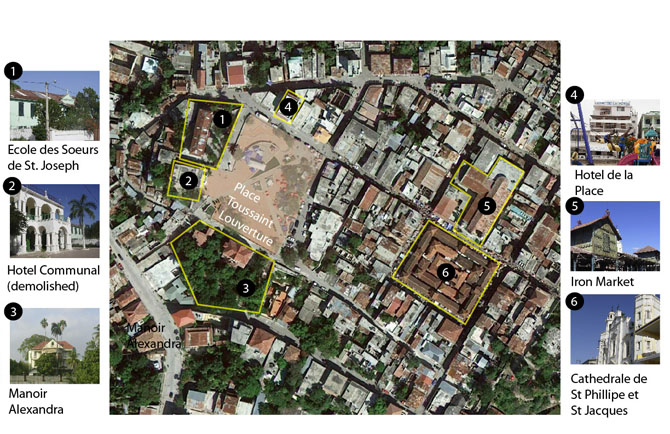
Even though there are these fantastic media outlets, the major earthquake, plus lack of preservation and restoration have led to the gradual disappearance of not only public monuments and buildings, but their history. If one wishes to learn more about the city government of Jacmel, the backbone of all projects in the city, it is difficult to find specific information. The city hall of Jacmel was located on the West end of the Central Plaza of Jacmel (or “Place d’Armes”, recently named “Place Toussaint Louverture”) and had to be demolished because of severe damage after the earthquake.
For my architectural thesis, I would like to explore how best to link modern citizenry to the government, through the preservation of the Hotel Manoir Alexandra. The goal is to transform the 18th centruy masonry residential building into Jacmel’s new city hall, a transparent and accessible model of government.

Welcome
The purpose of this blog is to document the research, inspiration and design process of my Final Architecture thesis at RISD.
At first I was interested in the broad subject of Urbanism in Haiti, not knowing exactly where to settle. I explored the need for decentralization of the capital city of Port-au-Prince and how an effective transportation system could help branch out the dense population to the rest of the country. The idea was to promote the other cities and make them accessible through a reform and better regulation of the Tap-tap system.
Tap-taps are colorful privately owned buses or pick-up trucks. They are used for public transportation around the country. They are called tap-tap because one has to tap the side of the vehicle twice to let the driver know they’ve arrived to their destination.

 Le Manoir Alexandra